
On Seeing and Not Seeing Things
How we conspire to imagine the impossible and ignore the probable

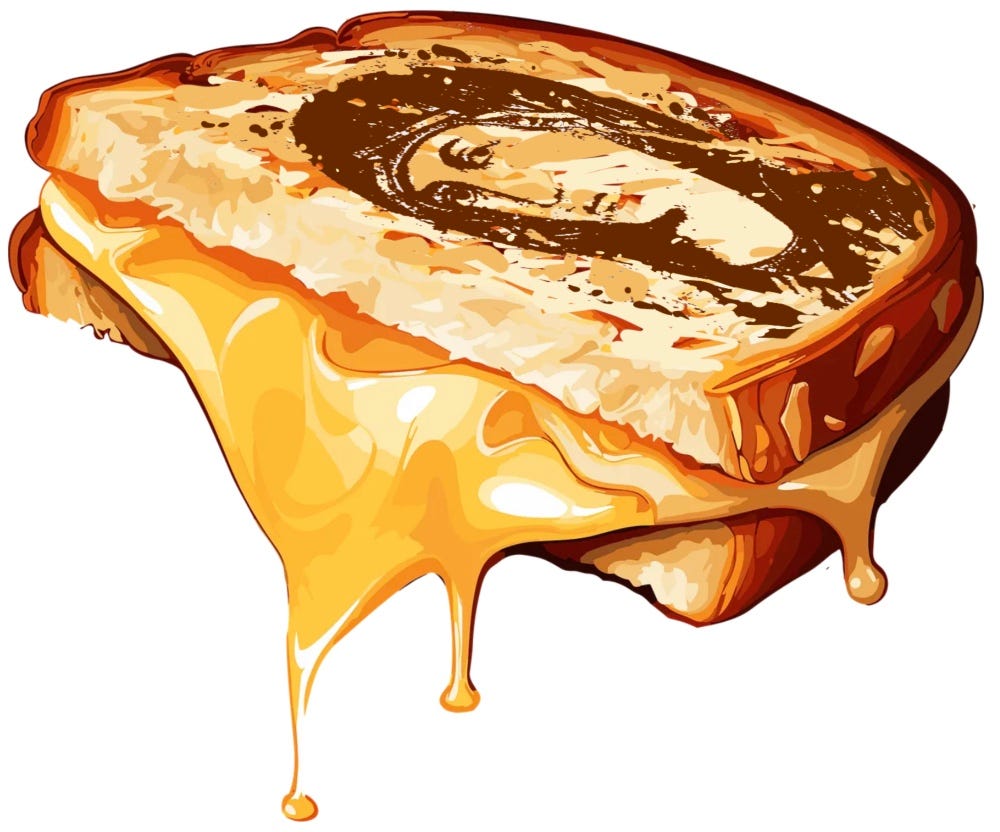
In 2004, a woman in Florida made $28,000 on eBay by selling a cheese sandwich she said bore the image of the Virgin Mary. In July of 1997, a woman in north England sliced open nine aubergines for a curry and was amazed to discover the Hindu symbol for God on every slice.
A year before, just before the Feast of Ramadan, a farmer in Senegal discovered a watermelon upon which the name of Allah had magically appeared.
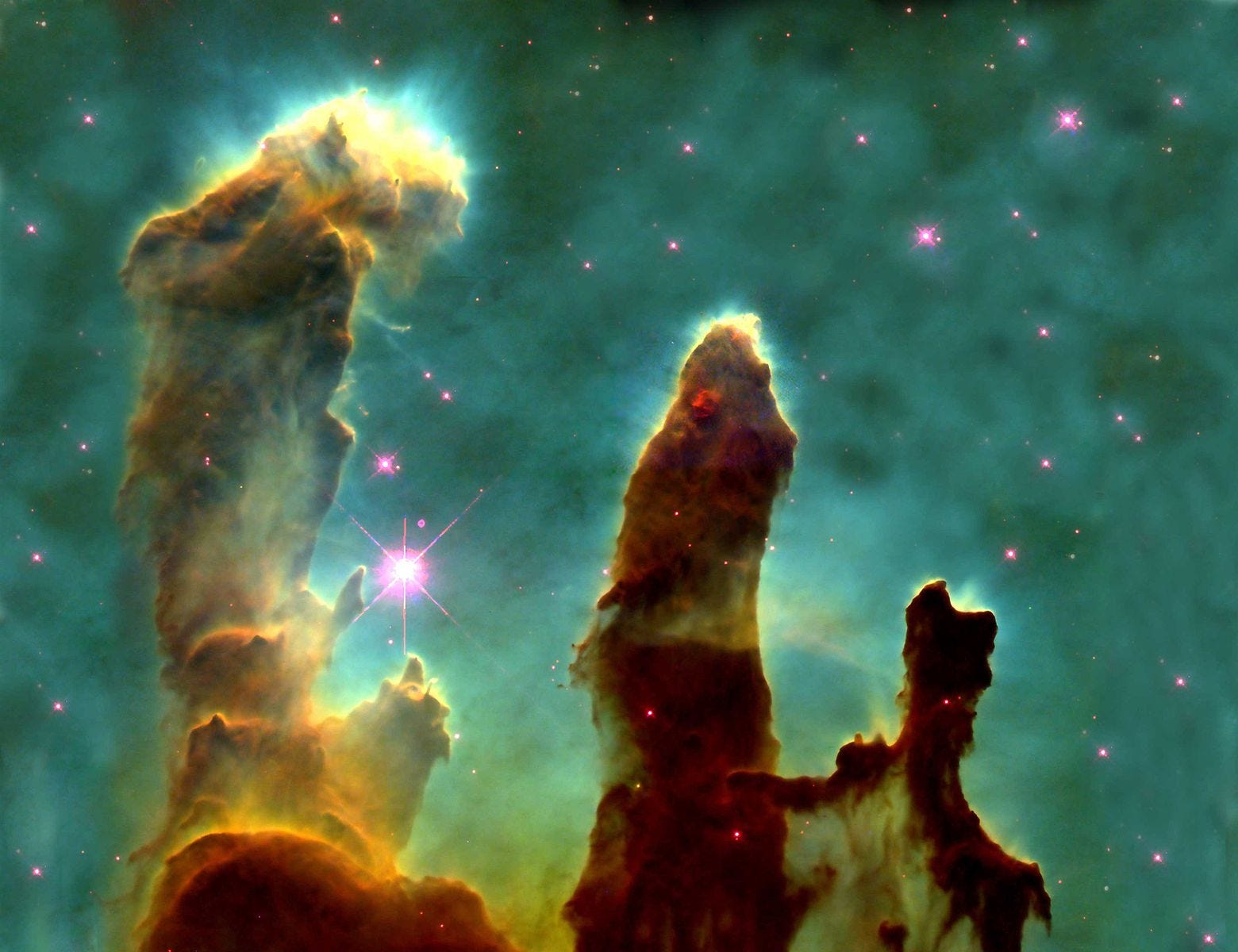
When CNN broadcast the stunning photographs by the Hubble space telescope of the Eagle nebula in 1995, American viewers called in claiming to see the face of Jesus in the glowing columns of interstellar gas. I recall CNN anchors nodding sagely as viewers expressed their wonderment at this heavenly high-five from God’s son.
Whether it’s foodstuffs with a blessed-before date, or messiah-marquees in space, the science buff in me finds this sort of thing somewhere between amusing and appalling. Of course, magical thinking is for the religious fundamentalists in the megachurches and madrasahs, right? It’s different for the educated sorts of the post-enlightenment, who understand the real world.
Right?
Wrong. If we’ve learned anything during the past four-year shit show of bought-off politicians, media-massaged misinformation, and outright pseudoscience, it’s that intelligent, well-educated people can see both too little and too much into different things. Science-worshipping secular humanists can see patterns that aren’t there and fail to see patterns that are.
Let’s go back a bit.
Landmasses on the move
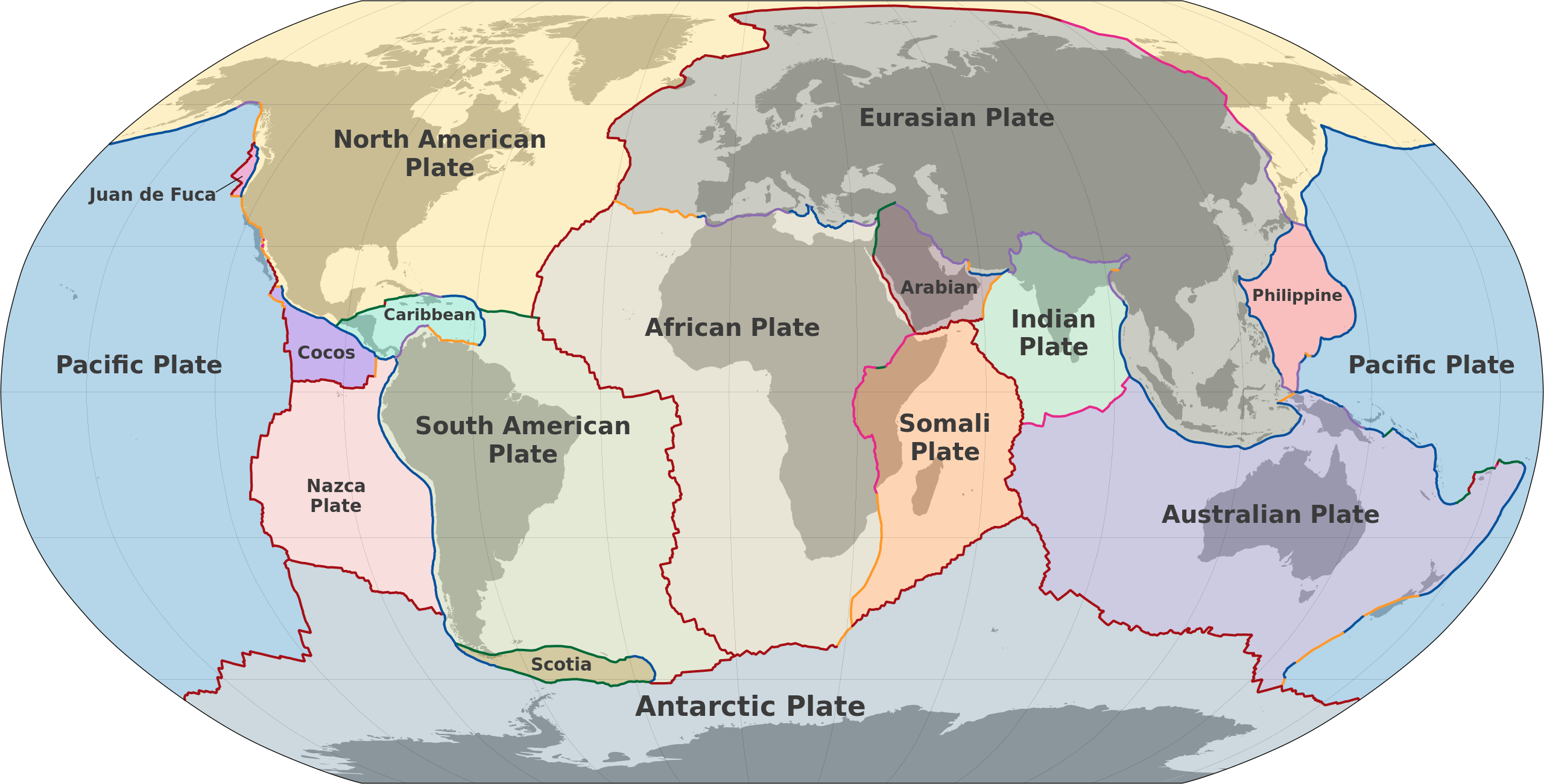
When I was a schoolkid back in the Upper Cretaceous, I used to marvel how closely the coastlines of Africa and South America matched up on a classroom map of the world. I was hardly the first kid to recognize this, of course, but there were no lessons geography lessons that explained this oddity. It was just one of those things.
Years later, I learned of a German meteorologist named Alfred Wegener, who in 1912 came up with the then-outlandish theory of ‘continental drift’ and died in scientific ignominy for his efforts.
For decades, geologists after Wegener could both ‘see’ and ‘not see’ that parts of the planet appeared to snap together like igneous lego, particularly when taking into consideration the continental shelves. And what about mineral deposits that mapped across distant landmasses, like floral patterns across dress seams? Never mind.
It took an enormous amount of data to shift scientific attitudes, largely through the mapping of the mid-Atlantic rift, an enormous scar of hardened magma. Almost reluctantly scientists had found a mechanism, through seafloor spreading, for continents to creep apart or closer by millimeters a year. Ergo, thousands of miles over millions of years.
Within the space of just a few years in the late sixties, the discipline of geophysics did a long-postponed pirouette towards the reality principle, with scientists eagerly embracing the new science of “plate tectonics.” And boom, now there was a planetary ur-story that explained earthquakes, volcanoes, mountain formation and other phenomenon.
Like patients awakening from a collective coma, geologists could suddenly see what was in front of them all along.
There are many of other examples of this kind of deferred seeing in the history of science. My point here is that highly educated people can be extremely selective in their attention. Something called the ‘social construction of reality’ gets in the way of a pristine, one-to-one correspondence between inner and outer worlds.
The sad truth is that through social pressure, groupthink, appeal to authority and the whole sorry smorgasbord of cognitive biases, smart people often fail to see patterns that are really there. This is the inversion of when less-smart people see things that aren’t really there.
Pareidolia, anyone?
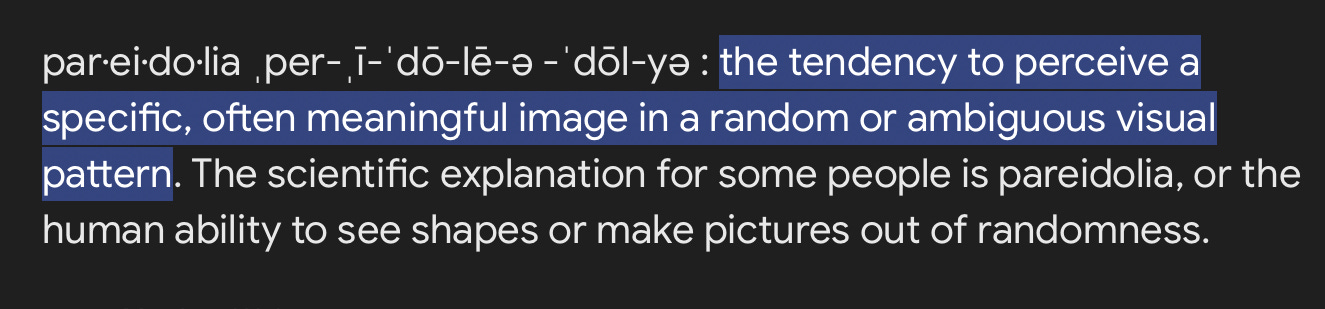
Pareidolia is a form of apophenia, which is “the tendency to perceive a connection or meaningful pattern between unrelated or random things (such as objects or ideas),” according to Wikipedia. For example, seeing the Virgin Mary in the random burn marks on a piece of toast.
Psychiatrists occasionally see the warning signs of mental illness - particularly paranoid schizophrenia - in patients who stitch this idea to that observation without any connective tissue of reason.
Evolution likely engineered the hominid nervous system for pattern-seeking overshoot. There were dire consequences millions of years ago on the African savanna for any australopithecus that mistook a crouching lion for a dusty boulder. “The best thing we have going for us is our intelligence, especially pattern recognition, sharpened over eons of evolution," noted Neil deGrasse Tyson in 2015.
“Pattern recognition according to IQ test designers is a key determinant of a person’s potential to think logically, verbally, numerically, and spatially,” observed Robert C. Barkman in Psychology Today. He adds that compared to other mental abilities, “pattern recognition is said to have the highest correlation with so-called general intelligence factor.”
Yet it’s a fine line between the paranoia of over-connection and the existential risk of under-connection.
Randomania?
If apophenia is the discovery of patterns in (apparently) random information, what do we call its opposite, the failure to recognize patterns in nonrandom information? I couldn’t find anything in a brief Google hunt, other than one proposed term from an article in a parapsychology journal:
“Perhaps we should call this opposite phenomenon of attributing chance probability to (apparently) related phenomena randomania, as a label for believing that everything one cannot currently explain is just due to chance and coincidence.”
(A friend put the question to ChatGPT, and it responded: “For the concept of not seeing patterns that are actually present, you could consider the term “pattern blindness”or “pattern neglect.””)
As most of my subscribers know, it doesn’t take much connecting of dots to be pegged as a “conspiracy theorist.” All you have to do is to point to some suspect confluence of power and profit - or draw attention to some extraordinary outlier in the establishment narrative begging for further examination - and the self-described skeptics will sniff, ‘mere coincidence.”
The most vocal among them, seemingly in the grip of ‘randomania,’ insist that any unusual signals outside establishment endorsement are just noise: the ho-hum hum of the mundane, amplified into fairy tales by the tin-foil hat crowd. (And they certainly won’t look it into any strange claims themselves - that would “doing their own research”.)
Ironically enough, these sorts have an almost religious faith in legacy news, The Science™, and establishment-endorsed “fact checkers.” In the past, such believers would have dismissed continental drift as geological madness, and Alfred Wegener as a five-star nutcase.
Since self-described skeptics love to bandy about the terms, ‘conspiracy theory’ and ‘conspiracy theorist,’ as all-purpose, ad hominem bludgeons, can we settle on an epithet or two for the “tinfoil hat” crowd to fire back with? How about “coincidence theorist,” or “randomaniac”?
Seeing things
I don’t have the space to get into specifics on the contending claims of the past few years, from the Covid pandemic to ‘safe and effective’ vaccines to ‘Russiagate’ to the Ukraine to 5G networks. For today, I prefer to highlight how all of us - whether we hail from the ‘conspiracy’ or ‘coincidence’ end of the spectrum - are stuck with nervous systems engineered to find what we are looking for, and that it takes some humility to recognize that we all get it wrong some of the time. A supreme effort is required to recognize when we’ve been mistaken - or worse yet, taken.
Take a moment to watch this minute and half film.
(This is a famous experiment that shows people in black and white shirts passing a basketball back and forth. Viewers gathered to watch the film are instructed to count the number of times the basketball is passed. As the ball goes around, a figure in a gorilla suit walks into the scene. The figure turns to the camera and beats her chest, before walking off-screen.)
According to Daniel J. Simons, the psychologist who produced the film, 50 percent of instructed viewers fail to see the figure in the first screening, due to what he calls “inattentional blindness.” That’s right; fully half the people viewing the film fail to see a person in a gorilla suit walking across their field of vision.
In a larger sense, we all suffer from inattentional blindness, editing out any anything solid that doesn’t fit our worldviews (through randomania), and editing in anything that isn’t (through aphophenia). Through this process, we clever monkeys turn kitchen foodstuffs into religious fetishes, or scientific findings into ‘antivaxer’ jokes.
We’re like hard-nosed news reporters hunting down a few local stories, while ignoring dozens of leads for front-page features. None of us want to believe we’ve missed a scoop.
Have you heard?
On his speaking tours, the late American philosopher Robert Anton Wilson occasionally had his audiences engage in a Sufi listening exercise. After handing out pens and paper, he asked the people in the auditorium to sit in silence and listen intently, while writing down all the sounds they could hear: distant traffic outside the auditorium, creaking chairs, fabric rustling as people shifted in their seats, etc.
When Wilson asked for a show of hands, he found the most sounds heard by any one person usually came to almost two dozen. He then asked the audience if anyone had heard anything this fellow had not. The author added these sounds to the list, for a total of over forty. Wilson had led this exercise plenty of times before in other talks and this was a consistent score. This proved, he said, that even the most observant person in a large room full of people was aware of only half of what was going on.
The situation for human intellectual pride may be even more dire, insists Donald Hoffman:
There’s a flip side to this, of course.
In Myth and Meaning, anthropologist Claude Lévi-Strauss wrote of his initial shock when he discovered that “a particular tribe” of Central American aboriginals could see the planet Venus in full daylight with the naked eye. He describes it as “… something that to me would be utterly impossible and incredible.” But when he learned from astronomers it was feasible, he concluded that “today we use less and we use more of our mental capacity than we did in the past.”
Most academics of the time would have simply said the aboriginal tribesmen were “seeing things.” In his book Breaking Open the Head, Daniel Pinchbeck commented on Levi-Strauss’ discovery:
We have sacrificed perceptual capabilities for other mental abilities to concentrate on a computer screen while sitting in a cubicle for many hours at a stretch – something those Indians would find ‘utterly impossible and incredible’ – or to shut off multiple layers of awareness as we drive a car in heavy traffic. In other words, we are brought up within a system that teaches us to postpone, defer and eliminate most incoming sense data in favour of a future reward. We live in a feedback loop of perpetual postponement. For the most part, we are not even aware of what we have lost.
“Seeing things” can mean many things, from looking deeply into the heart of nature to outright hallucination. In the end, I believe our survival on this planetary ship of fools depends on us learning to see things as they are, rather than what we prefer them to be.

That was a great think piece, or whatever the kids call serious writing these confusing days. And I learned a new word; so a double dip. Pattern recognition and attentive blindness are fascinating aspects of human thought processes and I loved that Levi Strauss story. Who, I wonder, reads him today? He used to be one of my intellectual heroes...speaking of which, I am reading a very disturbing book by Regina N Watteel, Fisman's Fraud, the rise of Canadian hate science. Poor subtitle but alas, she has a shocking story of high level corruption and malfeasance in the Canadian scientific establishment to tell. It's hard to read because it makes you realize that nobody has been held responsible for the vaccine oppression in Canada. Somebody has to, and soon...